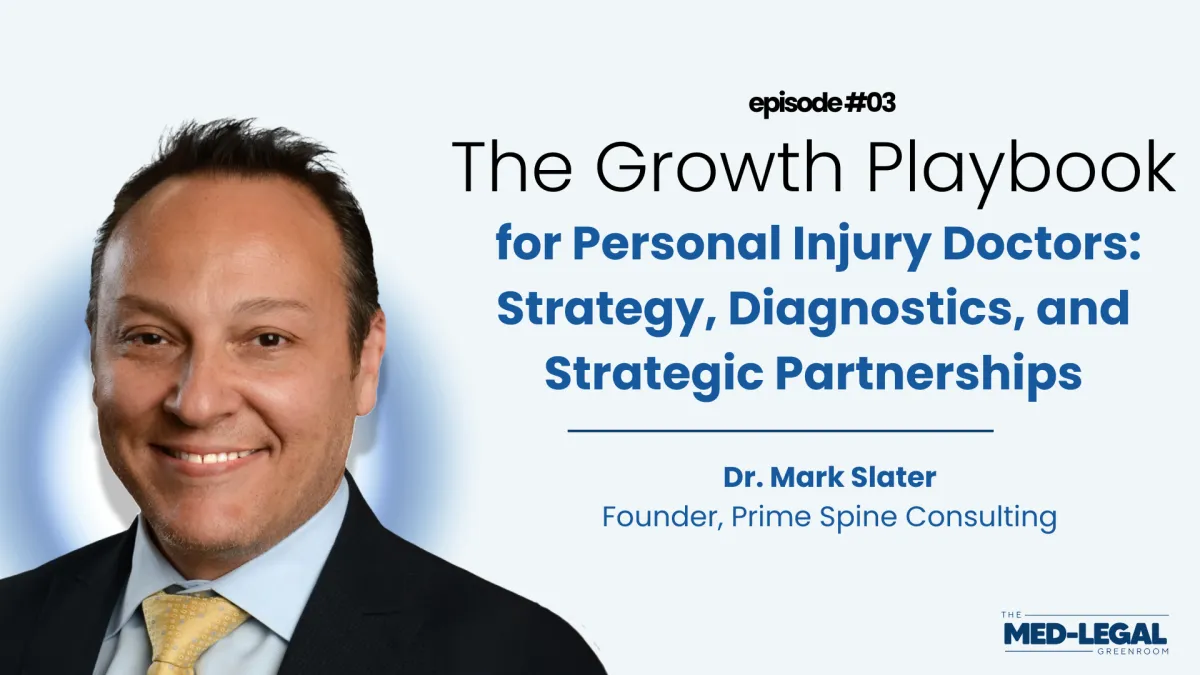
3 - The Growth Playbook for Personal Injury Doctors: Strategy, Diagnostics, and Strategic Partnerships
Elevating Your Personal Injury Practice: Objective Evidence and Strategic Growth with Dr. Mark Slater
In the high-stakes world of personal injury, the gap between a struggling practice and a thriving one often comes down to two things: the quality of your medical evidence and the consistency of your outreach. In the latest episode of The Med-Legal Green Room Podcast, host Sam Frentzas welcomes Dr. Mark Slater, the Founder of Prime Spine Consulting, to break down the mechanics of building an indispensable medical practice. With over 25 years of experience, Dr. Slater shares how providers can move beyond the "commodity" trap of subjective complaints to become the go-to experts that attorneys rely on for high-value, defensible cases.
The Shift from Subjective Symptoms to Defensible Clinical Data
Many personal injury providers find themselves in a constant battle with insurance adjusters who dismiss patient pain as "soft tissue" injuries that should heal in weeks. Dr. Slater explains that this friction exists because many clinicians rely solely on subjective complaints like stiffness or headaches, which are easily challenged in court. To break this cycle, a practice must pivot toward objective medical evidence—measurable data points like ligament laxity quantified through Vertebral Motion Analysis (VMA) or cognitive deficits identified via FDA-cleared Traumatic Brain Injury (TBI) screening. When a doctor can present a permanent impairment rating backed by hard data, the conversation with both attorneys and insurance companies changes from a debate over "soreness" to an undeniable discussion about structural damage.
The strength of a personal injury case is often decided during the very first patient encounter, making initial clinical documentation the most critical part of the process. Dr. Slater warns against "diagnosis drift," where advanced testing is ordered months into treatment without any mention of corresponding symptoms in the early notes. To be a true asset to a legal team, a provider must capture a comprehensive symptom profile from day one—documenting everything from dizziness to minor cognitive "fog." This thoroughness ensures that when objective testing eventually confirms a TBI or a spinal injury, the narrative remains consistent and immune to defense claims that the symptoms were exaggerated or unrelated to the accident.
Beyond the clinical realm, scaling a practice requires a move away from "hope-based" marketing toward a disciplined, systems-driven approach. Many doctors make the mistake of hiring a marketing liaison and providing no direction, resulting in wasted payroll and zero new referrals. Dr. Slater advocates for a model built on clear Key Performance Indicators (KPIs) and consistent relationship-building. By treating marketing as a professional system—utilizing tools like automated LinkedIn outreach or joining elite peer masterminds—doctors can build a robust referral pipeline that doesn't require them to sacrifice their time at the table. This allows the physician to focus on what they do best: providing elite-level care that is supported by bulletproof documentation.
About Dr. Mark Slater
Dr. Mark Slater is a veteran clinician and the Founder of Prime Spine Consulting. He is widely recognized for his expertise in teaching medical providers how to integrate advanced diagnostics and strategic business systems into their personal injury practices to maximize both patient outcomes and case values.
About Prime Spine Consulting
Prime Spine Consulting is a specialized advisory firm that helps personal injury doctors scale their businesses through clinical excellence and sophisticated marketing. They provide the frameworks for objective medical documentation, TBI protocols, and liaison training that turn standard clinics into elite med-legal powerhouses.
Links Mentioned in This Episode
Guest Company: Prime Spine Consulting
Guest LinkedIn: Dr. Mark Slater on LinkedIn
Conclusion
Building a successful personal injury practice is about more than just being a great doctor; it’s about speaking the language of objective evidence and implementing the systems that allow your expertise to be seen. As Dr. Slater emphasizes, when you provide the data that wins cases, you stop chasing attorneys and start being sought after by them.
The Objective Evidence Gold Standard: Why VMA imaging and cognitive testing are essential for proving permanent impairment.
The "Liaison Trap": How to avoid the common mistakes of hiring marketing staff without measurable KPIs and strategic direction.
Early TBI Assessment: The critical importance of screening for brain injuries immediately to prevent "diagnosis drift" in legal cases.
Innovation vs. Commodity: Why practices that offer advanced diagnostics naturally stand out in a crowded referral market.
The Power of Masterminds: Shortening the learning curve by collaborating with high-performing peers in the med-legal space.
To learn more about optimizing your personal injury practice and staying ahead of industry trends, visit drivingforcecompany.com.
Do you have a unique perspective on the intersection of medicine and law? We are always looking for industry leaders to share their wisdom. Apply to be a guest on The Med-Legal Green Room Podcast here and let’s start a conversation that drives the industry forward.
