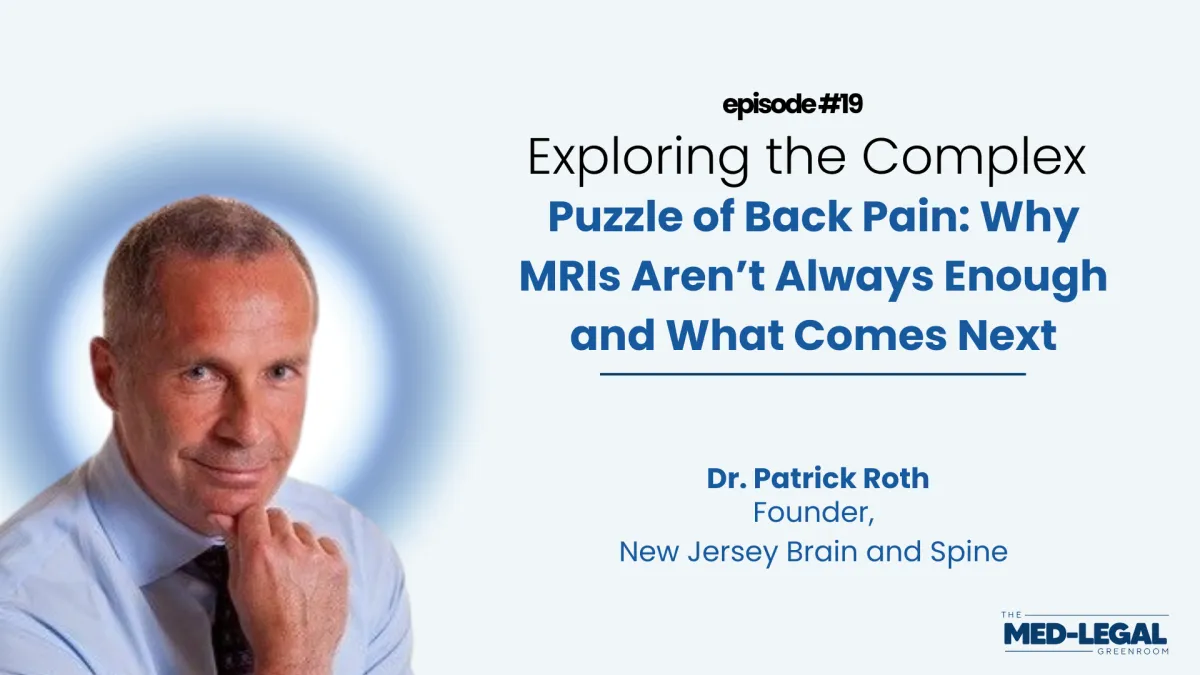
22 - Exploring the Complex Puzzle of Back Pain: Why MRIs Aren’t Always Enough and What Comes Next
Beyond the MRI: A Comprehensive Guide to Diagnosing and Managing Back Pain
In this insightful episode of The Med-Legal Green Room Podcast, host Sam Frentzas sits down with Dr. Patrick Roth, the Founder of New Jersey Brain and Spine, to deconstruct the diagnostic pitfalls and clinical blind spots that plague modern spinal care. Despite major technological advances, pinpointing the true root cause of back pain remains one of the most complex challenges in medicine, frequently leaving both clinicians and patients trapped in a cycle of failed treatments. Dr. Roth draws on his decades of expertise as a top neurosurgeon to challenge the over-reliance on static imaging, offering a clear roadmap for combining dynamic diagnostic tools with a comprehensive understanding of how pain manifests physically and neurologically.
The Limits of Static Imaging and the Three-Tier Model of Pain
The fundamental mistake in modern spine management is treating a magnetic resonance image (MRI) as a definitive answer rather than a single piece of a broader diagnostic puzzle. While MRIs excel at identifying acute nerve root compression—which typically presents as radiating leg or arm pain—they provide a definitive, actionable diagnosis in only about half of all back pain cases. Dr. Patrick Roth points out that static imaging regularly produces false positives and false negatives, capturing structural anomalies in asymptomatic individuals while failing to show the dynamic instability or active tissue inflammation causing a patient's true suffering. To bridge this diagnostic gap, practitioners must utilize advanced tools like Single Photon Emission Computed Tomography (SPECT) scans to pinpoint active metabolic inflammation, alongside standardized flexion-extension X-rays that capture the spine under motion to reveal subtle vertebral instability.
Understanding chronic back pain requires looking beyond structural damage and evaluating the condition through a three-tier model: the primary physical pain generator, the body’s physical adaptations, and the brain’s neurological processing. When an initial tissue injury occurs, the body often responds with compensatory muscle spasms, altered posture, and guarded movement patterns that perpetuate discomfort long after the original injury should have healed. Furthermore, the central nervous system processes, filters, and amplifies pain signals based on past trauma, stress, and expectations. When medical providers fail to account for these adaptive and neurological tiers, they risk misinterpreting a patient's symptoms or defaulting to invasive, single-specialty interventions that fail to address the root cause of the distress.
Navigating complex spinal cases demands that medical providers and legal advocates dismantle the "hot potato" syndrome, where patients are bounced between specialists who only offer treatments within their specific discipline. Surgeons naturally lean toward surgery, interventionalists default to injections, and physical therapists focus exclusively on rehab, leaving the patient without a unified, cohesive care strategy. Overcoming this specialty bias requires a collaborative, multidisciplinary approach that validates the patient's subjective narrative and correlates diagnostic imaging directly with clinical physical exams. By combining dynamic diagnostic testing with targeted physical and cognitive therapies, clinicians can establish undisputable medical causation, build defensible legal cases, and deliver genuine, long-term relief to chronic pain sufferers.
About Dr. Patrick Roth
Dr. Patrick Roth is a renowned neurosurgeon, author, and the Founder of New Jersey Brain and Spine. A leading voice in minimally invasive spine surgery and non-surgical back pain management, he has authored popular books including Managing Back Pain for Dummies and The End of Back Pain, dedicating his career to patient empowerment, empathetic care, and evidence-based spinal diagnostics.
About New Jersey Brain and Spine
New Jersey Brain and Spine is a premier neurosurgical and spine care practice offering comprehensive, state-of-the-art treatment for complex brain, neck, and spinal conditions. The practice integrates advanced surgical techniques, cutting-edge diagnostic technology, and conservative care models to deliver highly personalized, patient-centered clinical outcomes.
Links Mentioned in This Episode
Guest Company: New Jersey Brain and Spine
Guest LinkedIn: Dr. Patrick Roth on LinkedIn
Key Episode Highlights
The MRI Diagnostic Gap: Recognizing that standard MRIs fail to identify a clear pain generator in approximately 50% of back pain cases.
Advanced Diagnostic Modalities: Utilizing SPECT scans to highlight active tissue inflammation and flexion-extension films to detect hidden vertebral instability.
The Three-Tier Pain Framework: Deconstructing pain into the primary tissue stimulus, the body's physical adaptations, and the brain's neurological processing.
Eliminating Specialty Bias: Overcoming the "hot potato" phenomenon by avoiding single-treatment approaches and building multidisciplinary care teams.
Empowered Patient Advocacy: Encouraging patients and trial attorneys to demand comprehensive physical evaluations and second opinions when static imaging is inconclusive.
Conclusion
This eye-opening conversation with Dr. Patrick Roth highlights that conquering chronic back pain requires moving beyond static diagnostic models and embracing a multi-dimensional approach to patient care. By pairing dynamic imaging with empathetic, multidisciplinary evaluation, both healthcare providers and legal advocates can confidently expose hidden structural damage, ensure accurate medical causation, and guide patients toward lasting recovery.
To learn more about how to optimize your professional growth and secure your business future, visit drivingforcecompany.com for more expert insights.
Are you a leader in the medical or legal field with a story of growth and autonomy to share? We want to hear from you! Apply to be a guest on The Med-Legal Green Room Podcast here and join our community of elite professionals.
