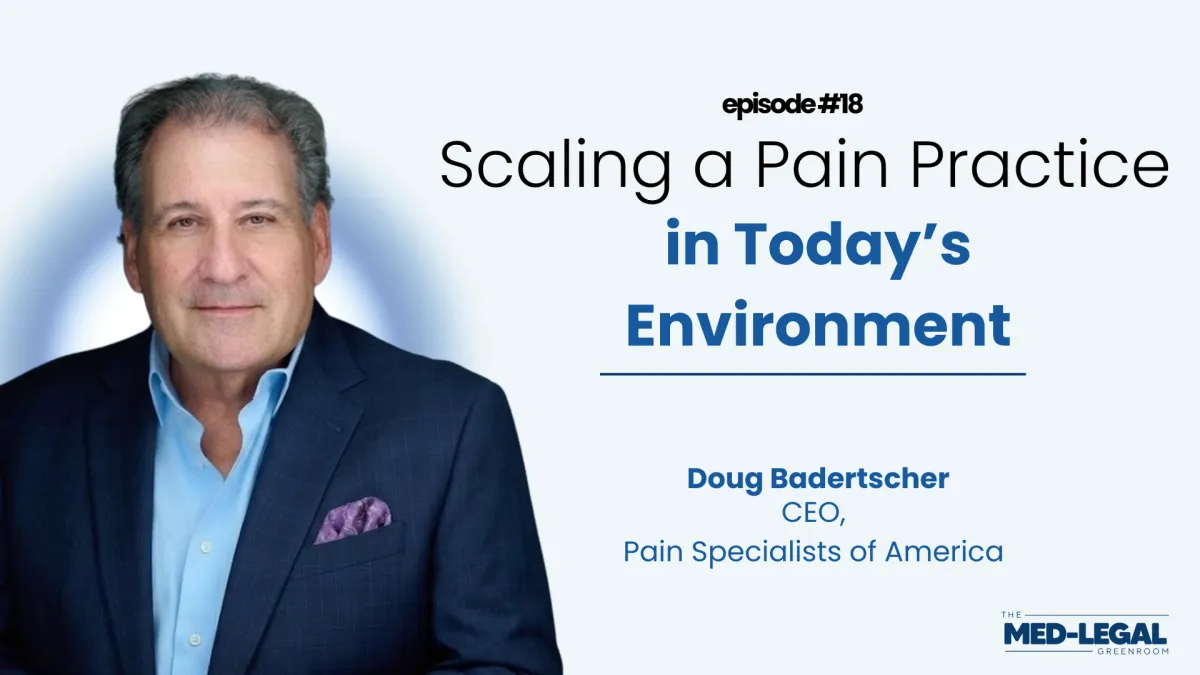
18 - Scaling a Pain Practice in Today’s Environment
Scaling Medical Practices: Operational Strategies for Healthcare Leaders with Doug Badertscher
In the latest episode of The Med-Legal Green Room Podcast, host Sam Frentzas sits down with Doug Badertscher, the CEO of Pain Specialists of America, to deconstruct the massive shifts happening in healthcare practice management. Over the past two decades, the healthcare landscape has transformed from local "mom and pop" clinics into a complex, highly consolidated ecosystem dominated by regional platforms, private equity, and strict compliance demands. Drawing from more than 25 years of executive healthcare experience in spine orthopedics, interventional pain, and diagnostic imaging, Doug Badertscher reveals why traditional clinical management models fail today and outlines the exact operational frameworks physicians need to scale sustainably.
Bridging the Physician Business Gap Through Strategic Operational Frameworks
A major vulnerability for modern medical practices is the profound business education deficit among physicians. While medical schools excel at producing elite clinicians, fewer than 2% of healthcare providers enter practice ownership with a formal business plan or a working knowledge of corporate risk, financial benchmarks, and practice valuation. In an era where clinical salaries have surged while insurance reimbursements remain stagnant, running a practice without a disciplined operational strategy is a recipe for severe financial squeeze. To navigate these modern headwinds, practice owners must move beyond reactive management and implement sophisticated infrastructure—benchmark salaries, negotiate technology vendor contracts, and diversify payer mixes to build a resilient foundation.
To scale effectively without sacrificing quality or culture, practice leaders must deploy a structured operational framework built around clear priorities: Patients, People, Physicians, and Profits. Placing the patient experience first means expanding access through streamlined scheduling, convenient locations, and digital communication tools. Building a high-performance culture requires recruiting ambitious, culturally aligned clinical staff and establishing clear guardrails for physicians—such as standardized operational guidelines and dedicated Chief Medical Officer oversight. When a practice prioritizes patient satisfaction, employee retention, and physician alignment, financial profitability naturally follows as an outcome rather than a forced metric.
Navigating today's healthcare market also demands a cautious, highly strategic approach to technology integration and private equity partnerships. While Electronic Health Records (EHRs), practice management systems, and emerging AI tools promise greater efficiency, non-integrated technology often creates administrative clutter and workflow bottlenecks. Healthcare executives must prioritize systems that offer seamless interoperability and pilot new tools before full deployment. Furthermore, for practices considering private equity backing for capital and scale, success hinges on rigorous due diligence to ensure cultural alignment and preserve clinical autonomy, ensuring the practice thrives long-term amid regulatory changes.
About Doug Badertscher
Doug Badertscher is a seasoned healthcare executive and the CEO of Pain Specialists of America. With over 25 years of experience leading complex healthcare organizations, he specializes in physician practice management, private equity transactions, corporate operations, and scaling multi-site medical platforms across spine, pain, and orthopedic sectors.
About Pain Specialists of America
Pain Specialists of America is a premier interventional pain management platform dedicated to providing advanced, multi-disciplinary pain relief solutions. The organization operates state-of-the-art clinical centers and ambulatory surgery centers, leveraging cutting-edge diagnostics, evidence-based treatments, and patient-centered care models to improve long-term outcomes.
Links Mentioned in This Episode
Guest Company: Pain Specialists of America
Guest LinkedIn: Doug Badertscher on LinkedIn
Key Episode Highlights
The Business Education Deficit: Why fewer than 2% of medical practices have a formal business plan and how physicians can bridge the business acumen gap.
The "Three P’s" Operational Framework: Prioritizing Patients, People, and Physicians to drive sustainable financial Profits.
Managing Margin Squeezes: Strategies for handling soaring clinical salaries and inflation alongside stagnant insurance reimbursements.
Technology Interoperability: Avoiding administrative bottlenecks by selecting vetted, fully integrated EHR and practice management platforms.
Navigating Private Equity: Conducting thorough due diligence to preserve practice culture and clinical autonomy during consolidation.
Conclusion
This insightful discussion with Doug Badertscher proves that scaling a successful medical practice in today's environment requires pairing clinical excellence with rigorous business strategy. By prioritizing patient accessibility, investing in high-performing teams, and adopting structured business frameworks, practice leaders can build resilient, highly profitable organizations.
To learn more about how we help high-level professionals optimize their lives and businesses, head over to drivingforcecompany.com for more expert insights.
Are you a medical or legal professional with a breakthrough story or system to share? We’d love to have you in the room. Apply to be a guest on The Med-Legal Green Room Podcast here and join our community of elite industry leaders.
