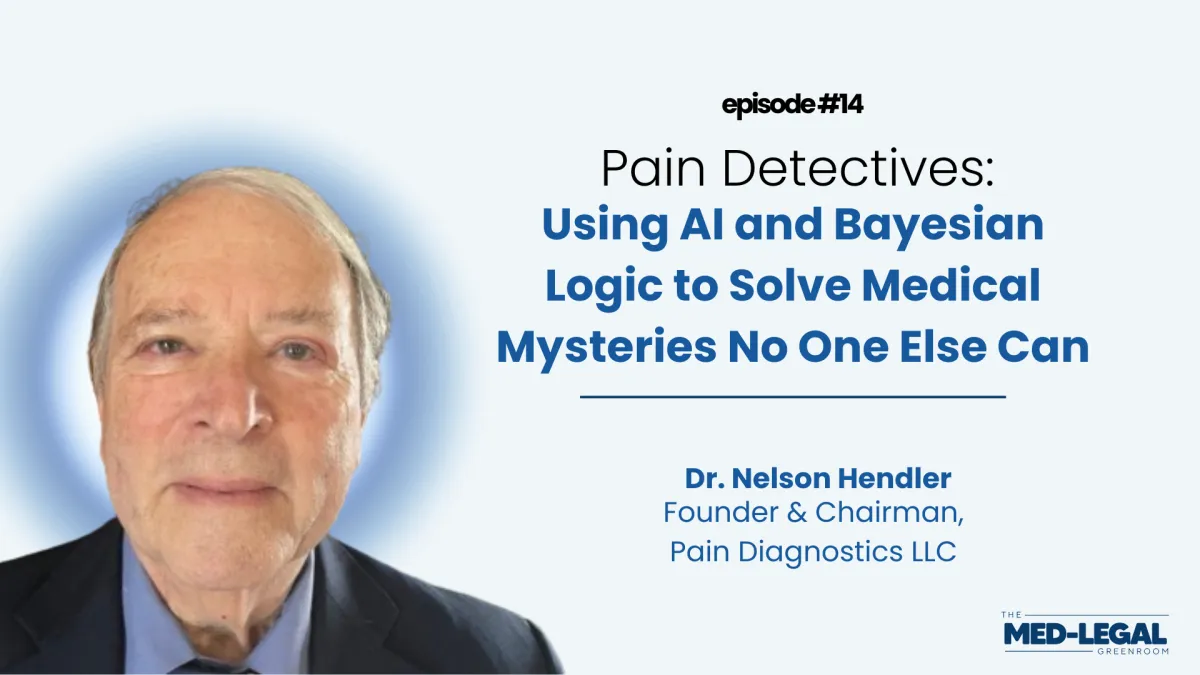
14 - Pain Detectives: Using AI and Bayesian Logic to Solve Medical Mysteries No One Else Can
Uncovering the Hidden Causes of Chronic Pain: Expert Insights from Dr. Nelson Hendler
In this gripping episode of The Med-Legal Green Room Podcast, host Sam Frentzas sits down with Dr. Nelson Hendler, the Founder and Chairman of Pain Diagnostics, LLC, to expose why millions of chronic pain sufferers and personal injury victims are routinely misdiagnosed by the modern healthcare system. Driven by declining insurance reimbursements, the average doctor's visit has shrunk to a mere eleven minutes, leaving only four minutes to capture a patient's history—a systemic constraint that inevitably forces clinicians to rely on superficial answers. Dr. Hendler uses his extensive background as a researcher and former Johns Hopkins faculty member to reveal how this widespread "time crunch" creates severe diagnostic blind spots, offering a definitive roadmap for clinicians, trial lawyers, and patients who are tired of falling through the cracks.
Moving Past Static Snapshots: Shifting to Objective, Physiological Diagnostics
The fatal flaw within traditional orthopedic and personal injury medicine is the absolute over-reliance on static anatomical imaging like standard MRIs and CT scans. Dr. Nelson Hendler reveals that these tests are merely static snapshots taken while a patient is completely still, meaning they miss dynamic, positional injuries—such as missing up to 77% of disc pathologies compared to provocative discograms, and failing to detect up to 80% of soft-tissue or ligament laxity captured through flexion-extension X-rays. Because standard scans fail to "see" pain—which is a live, physiological event—patients with genuine trauma are frequently dismissed, told their symptoms are psychosomatic, or misdiagnosed with generic "muscle spasms." To secure true clinical recovery and undisputed legal causation, providers must transition from binary Boolean decision-making to advanced physiological testing that actively replicates the patient's pain triggers under structural load.
This diagnostic gap is particularly devastating when evaluating complex, overlooked injuries common in auto accidents and workers' compensation cases. Traumatic Brain Injuries (TBIs) frequently occur during sudden acceleration-deceleration forces without any direct head impact, yet subtle symptoms like a lost sense of smell or sudden memory lapses are routinely ignored. Similarly, conditions like Thoracic Outlet Syndrome, painful annular tears without disc herniation, and Temporomandibular Joint (TMJ) syndrome after whiplash are consistently masked by normal radiology reports. Dr. Hendler also warns against the misinterpretation of standard EMGs and nerve conduction studies, which exclusively measure motor nerves while completely ignoring the sensory nerve fibers responsible for chronic pain. Even blunt physical trauma from seat belts and airbags can cause slipping rib syndrome—misidentifying a dislocated rib cage as a gastrointestinal emergency simply because clinicians fail to manually perform a physical provocative exam.
To solve this systemic crisis, Dr. Hendler developed an advanced diagnostic paradigm that leverages artificial intelligence and Bayesian logic to calculate overlapping clinical probabilities with extreme precision. His 72-question Diagnostic Paradigm Questionnaire yields a staggering 96% correlation with eventual diagnoses from Johns Hopkins Hospital, effectively replacing medical guesswork with a validated, multi-system assessment. Furthermore, his court-admissible Pain Validity Test predicts with 95% accuracy which patients will demonstrate objective abnormalities on targeted physiological testing, successfully separating genuine trauma victims from malingerers. When attorneys and clinicians integrate these advanced AI tools early in the litigation pipeline, they stop chasing subjective pain scores and instead construct a highly defensible, objective medical narrative that stands up under intense insurance scrutiny and secures the specialized care patients rightfully deserve.
About Dr. Nelson Hendler
Dr. Nelson Hendler is a world-renowned pioneer in pain medicine, researcher, and the Founder and Chairman of Pain Diagnostics, LLC. A former Assistant Professor of Psychiatry and Neurosurgery at Johns Hopkins University School of Medicine, he has authored four books, published over 115 medical articles, and dedicated his career to developing objective, AI-driven diagnostic tools for complex chronic pain.
About Pain Diagnostics, LLC
Pain Diagnostics, LLC is an innovative medical technology and consulting firm specialized in evaluating complex chronic pain and ambiguous musculoskeletal injuries. The company utilizes sophisticated Bayesian questionnaires and validated diagnostic testing paradigms to uncover root causes of pain, providing clinicians and legal teams with highly accurate, data-driven diagnostic solutions.
Links Mentioned in This Episode
Guest Company: Pain Diagnostics, LLC
Guest LinkedIn: Dr. Nelson Hendler on LinkedIn
Key Episode Highlights
The Four-Minute History Deficit: How systemic time pressures and compressed insurance models force modern physicians to miss critical diagnostic clues.
Anatomical vs. Physiological Testing: Understanding why a picture of an oven cannot tell you if it is hot, and why static MRIs routinely fail to capture active, physiological pain generators.
The Shaken Brain Phenomenon: Exposing how severe Traumatic Brain Injuries regularly occur via whiplash forces without a single direct impact to the skull.
Slipping Rib and Teacher’s Syndrome: Why seat belt and airbag trauma is frequently misdiagnosed as internal organ dysfunction due to a lack of simple physical palpation.
The Bayesian AI Solution: Utilizing a 72-point probabilistic questionnaire to match the diagnostic accuracy of top-tier research institutions and eliminate medical guesswork.
Conclusion
This eye-opening conversation with Dr. Nelson Hendler proves that conquering chronic pain requires moving past superficial, static testing and demanding absolute diagnostic precision. By replacing binary yes-or-no logic with AI-driven, physiological assessments, both medical providers and legal advocates can confidently expose hidden structural damage, ensuring patients receive the precise interventions and fair compensation required for a full recovery.
To learn more about how to optimize your professional growth and secure your business future, visit drivingforcecompany.com.
Are you a leader in the medical or legal field with a story of growth and autonomy to share? We want to hear from you! Apply to be a guest on The Med-Legal Green Room Podcast here and join our community of elite professionals.
