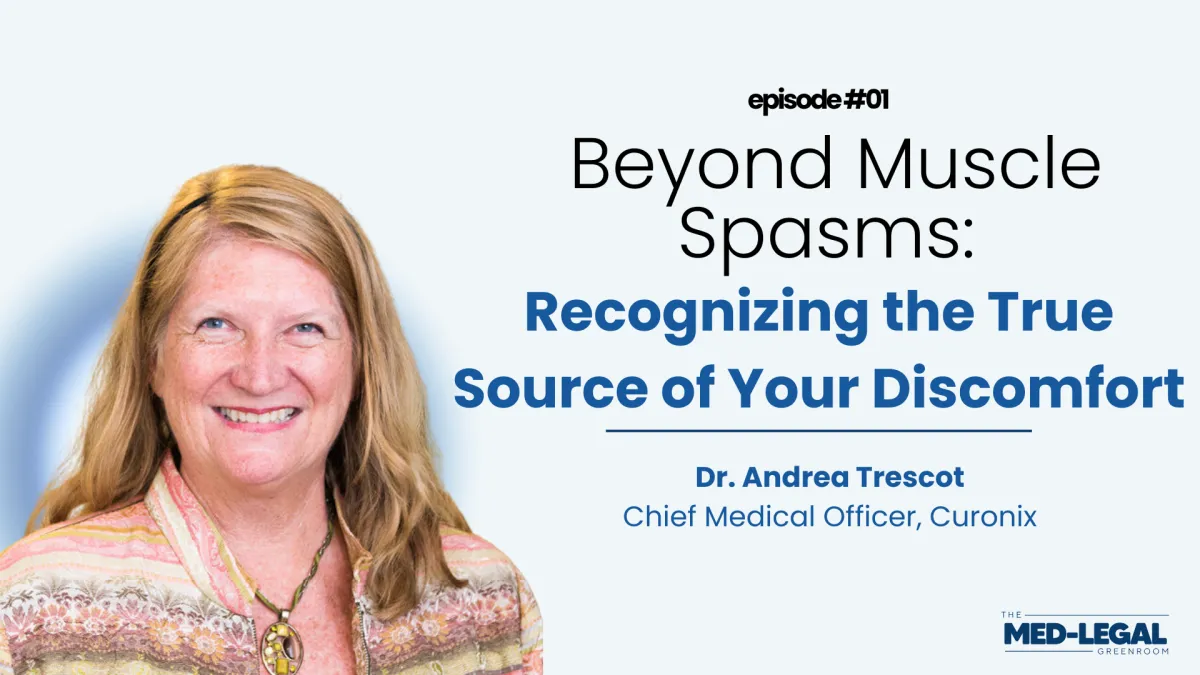
1 - Beyond Muscle Spasms: Recognizing the True Source of Your Discomfort
Beyond the Surface: Identifying the True Source of Chronic Spinal Pain
In this compelling episode of The Med-Legal Green Room Podcast, host Sam Frentzas welcomes Dr. Andrea Trescot, the Chief Medical Officer at Curonix, to discuss the clinical blind spots surrounding spinal ligament injuries. For many legal and medical professionals, chronic neck and back pain are often dismissed when standard MRIs come back "normal," leaving patients in a cycle of ineffective palliative care. Dr. Trescot brings her immense expertise in pain management and regenerative medicine to explain why these hidden injuries are the actual root cause of many debilitating symptoms, providing a roadmap for more accurate diagnosis and life-changing treatment.
Rethinking Spinal Instability and Regenerative Solutions
The fundamental issue in modern spinal care is the over-reliance on static imaging, which often fails to capture the dynamic nature of ligament laxity. Dr. Trescot points out that traditional MRIs are taken while a patient is lying still, completely missing the abnormal movement that occurs when a person is upright and active. This leads to a common misdiagnosis where "muscle spasms" are blamed for pain, when in reality, the muscles are simply seizing up to protect an unstable, ligament-damaged spine. By shifting the focus toward Video Motion Analysis (VMA), clinicians can finally obtain quantifiable, objective evidence of instability that holds up in both a clinical setting and a courtroom.
Once an injury is accurately identified, the conversation moves from merely masking symptoms to actually repairing the damage through regenerative medicine. Dr. Trescot highlights the efficacy of treatments like Prolotherapy, Platelet-Rich Plasma (PRP), and Stem Cell Therapy, which stimulate the body's natural healing response to tighten and strengthen weakened ligaments. Unlike traditional steroid injections or nerve ablations—which provide temporary relief while the underlying instability worsens—these regenerative approaches aim to restore the structural integrity of the spine. This is a game-changer for younger patients or those with recent trauma who want to avoid the downward spiral of invasive surgery.
From a legal perspective, the integration of advanced imaging and regenerative care provides a powerful narrative for personal injury and workers' compensation cases. When a board-certified neuroradiologist can point to objective data from a VMA, it validates the patient’s subjective pain and counters the argument that symptoms are psychosomatic. Sam Frentzas and Dr. Trescot emphasize that bridging the gap between cutting-edge medical science and legal advocacy is essential for ensuring patients receive the settlements and the treatments they need to truly recover.
About Dr. Andrea Trescot
Dr. Andrea Trescot is a world-renowned expert in pain management and the Chief Medical Officer at Curonix. A former Navy Commander and past president of the American Society of Interventional Pain Physicians, she has authored multiple textbooks and is a leading voice in the field of regenerative medicine and peripheral nerve surgery.
About Curonix
Curonix is a medical technology leader focused on developing innovative neurostimulation and regenerative solutions. The company is dedicated to providing minimally invasive treatments that address chronic pain at its source, helping patients regain their quality of life without heavy reliance on opioids or major surgery.
Links Mentioned in This Episode
Guest Company: Curonix
Guest LinkedIn: Dr. Andrea Trescot on LinkedIn
Conclusion
This conversation highlights a critical shift in how we must approach spinal injuries, moving away from palliative "band-aids" toward objective diagnosis and regenerative healing. By understanding the role of ligament laxity, professionals can better advocate for patients who have been told there is "nothing wrong" with their spine.
The Static Imaging Flaw: Why traditional MRIs miss dynamic ligament injuries and lead to chronic misdiagnosis.
The "Muscle Spasm" Myth: Understanding that spasms are often a secondary response to underlying spinal instability.
VMA as Objective Evidence: How Video Motion Analysis provides the quantifiable data needed for both medical recovery and legal settlements.
The Regenerative Advantage: Utilizing PRP and Prolotherapy to repair the root cause of pain rather than just blocking the signal.
To learn more about how we help medical and legal professionals stay at the forefront of their industries, visit drivingforcecompany.com.
Are you a leader in the med-legal space with a story or breakthrough to share? We want to hear from you! Apply to be a guest on The Med-Legal Green Room Podcast here and join the conversation.
